Will Your Breast Pump Last for Your Next Baby? Lifespan by Pump Type (2026)
You finally feel like you've figured out this whole pumping thing. You've got your schedule down, your flange fit dialed in, and your pump is doing its job. Now you're wondering: can I just box this thing up and pull it out for baby number two? It's a reasonable question, and one I get asked constantly. The short answer is: it depends on the pump, usage, and storage time — the answer matters more than most people realize. Breast pump longevity is not one-size-fits-all, and using a compromised pump can silently sabotage your milk supply before you even realize something's wrong.
I’m going to break down the current breast pump market, what you can realistically expect from each category in terms of lifespan, and how to make an informed decision about storing your pump for future use.
Why Breast Pump Lifespan Matters More Than You Think
Here's something the box doesn't tell you: most breast pumps are engineered with a finite lifespan, and once the motor starts to degrade, you may not notice it immediately. What you will notice — eventually — is a slow, frustrating decline in milk output that gets misattributed to low supply, hormones, or stress.
The mechanics behind this are straightforward. Over time, the motor loses efficiency, seals degrade, and the consistent vacuum pressure your breast tissue depends on for effective milk removal becomes erratic. Less effective milk removal = less stimulation = less prolactin = less milk. For exclusively pumping parents especially, this is not a minor inconvenience — it's a supply threat. For those planning to reuse a pump for a second or third child, understanding the expected lifespan of your specific device is non-negotiable.
The 2026 Breast Pump Market: What's Out There
The breast pump market has expanded dramatically over the last several years, and most of that expansion has come as a direct hit to the quality of pumps. Understanding the four major categories of pumps currently available, and where they fall on the reliability spectrum, is essential before you invest in or store any device.
Low-Quality Wearable Pumps (Under 6 Months)
These are the pumps flooding online marketplaces from unrecognized brand names, or standard manufacture names, often positioned as budget-friendly alternatives to established wearable devices. The marketing can be compelling — they all look similar to their higher-quality counterparts, yet often comes with a price tag that seems like a steal.
The reality? These pumps typically use inferior interior components and lower-grade seals that begin to deteriorate almost immediately under regular use. Most will not survive beyond six months of consistent use, and even within that window, their suction consistency can be unreliable. Storing one of these pumps for future use is essentially storing a paperweight.
Takeaway: These are not worth storing. If you used one for your first baby and it's still functioning, do not count on it for another full nursing journey. Do not expect it to be of use to another pumping parent, simply dispose of it.
Higher-Quality Wearable Pumps (1 – 1.5 Years)
Brands like Eufy, Willow, and Zomee occupy this tier but not exclusively. These are purpose-built wearable pumps with some form of genuine engineering investment behind them. They offer hands-free convenience, relatively quiet motors, and better-quality components than their generic counterparts.
That said, wearable pump technology still places significant strain on miniaturized motors, and the compact design necessarily limits motor size and robustness. Add to that the additional strain often placed on these pumps when flange sizing and bra fit fitting improperly. Users can generally expect a functional lifespan of one to one-and-a-half years under regular use — defined as two to four pumping sessions per day. If you pump exclusively or very frequently throughout your first postpartum year, your device is likely approaching the end of its reliable lifespan. If you do decide to store your wearable pump, you need to pull it out and charge the motors and turn them on every month to help battery life last.
Takeaway: Possible to store for a second baby if it was used lightly and is under a year old, but proceed with scrutiny. Have the resources to quickly replace the pumps when they fail during your next pumping journey. If storage lasts for longer than a year, do not keep the pumps. See the section on storage and testing below.
Portable Pumps (1.5 – 2 Years)
The portable pump category — including models like the Baby Buddha, Pumpables Genie Advance, and Zomee Z2 — hits a sweet spot of convenience and durability. The larger form factor allows for a more robust motor design, translating to greater longevity. With regular use, these devices typically last one-and-a-half to two years. Storage still matters, but these pumps can typically last one additional pumping journey.
Takeaway: A well-maintained portable pump used in the first year of life is often a viable candidate for storing and reusing. If you don’t wish to keep your pump, these typically hold a solid resale value when treated well.
Traditional Personal User Pumps (2 – 3 Years)
These are the workhorses most pumping parents rely on, models like the Spectra S1/S2, Unimom Opera, and Motif Luna (new version). They're full-size electric pumps with robust motors designed for regular daily use throughout a single nursing journey and potentially beyond. Unlike wearables and portables, these pumps prioritize durability and consistent suction performance over portability. A quality traditional personal user pump used for one breastfeeding journey and properly maintained can reasonably last two to three years. For parents planning multiple children with relatively short spacing, this makes the upfront investment significantly more economical over time. However, it's important to note that these are still classified as single-user devices, but they can absolutely be reused by the same parent across multiple pregnancies.
Takeaway: A solid candidate for storage and reuse across your own babies. These pumps were designed with multi-year durability in mind, but treat them as your personal equipment only.
Traditional Hospital-Grade Pumps (5 – 10 Years)
At the absolute base of the pyramid sit true hospital-grade pumps like the Limerick Joy, Ameda Platinum, and Medela Symphony. These are the pumps you see in hospital lactation rooms, NICU settings, or rentals with IBCLCs; these are purpose-built for multi-user clinical environments with closed-system motors that prevent any cross-contamination between users. The engineering behind hospital-grade pumps is fundamentally different. They're designed to run continuously across multiple users over the course of 5 to 10 years with proper maintenance. The motors are larger, more powerful, and built to withstand the kind of heavy-duty use that would destroy a consumer-grade pump in months. They're also significantly more expensive upfront, which is why many parents access them through insurance-covered rentals rather than outright purchase.
If you own a hospital-grade pump (not renting), it is hands-down the most reliable piece of equipment you could store for future babies. With proper care, replacement of parts, and periodic manufacture maintenance, these pumps can serve you across multiple children and even be safely passed on or donated for use by others with new personal kits.
Takeaway: The gold standard for longevity and reusability. If you have access to one of these through purchase, it's worth holding onto.
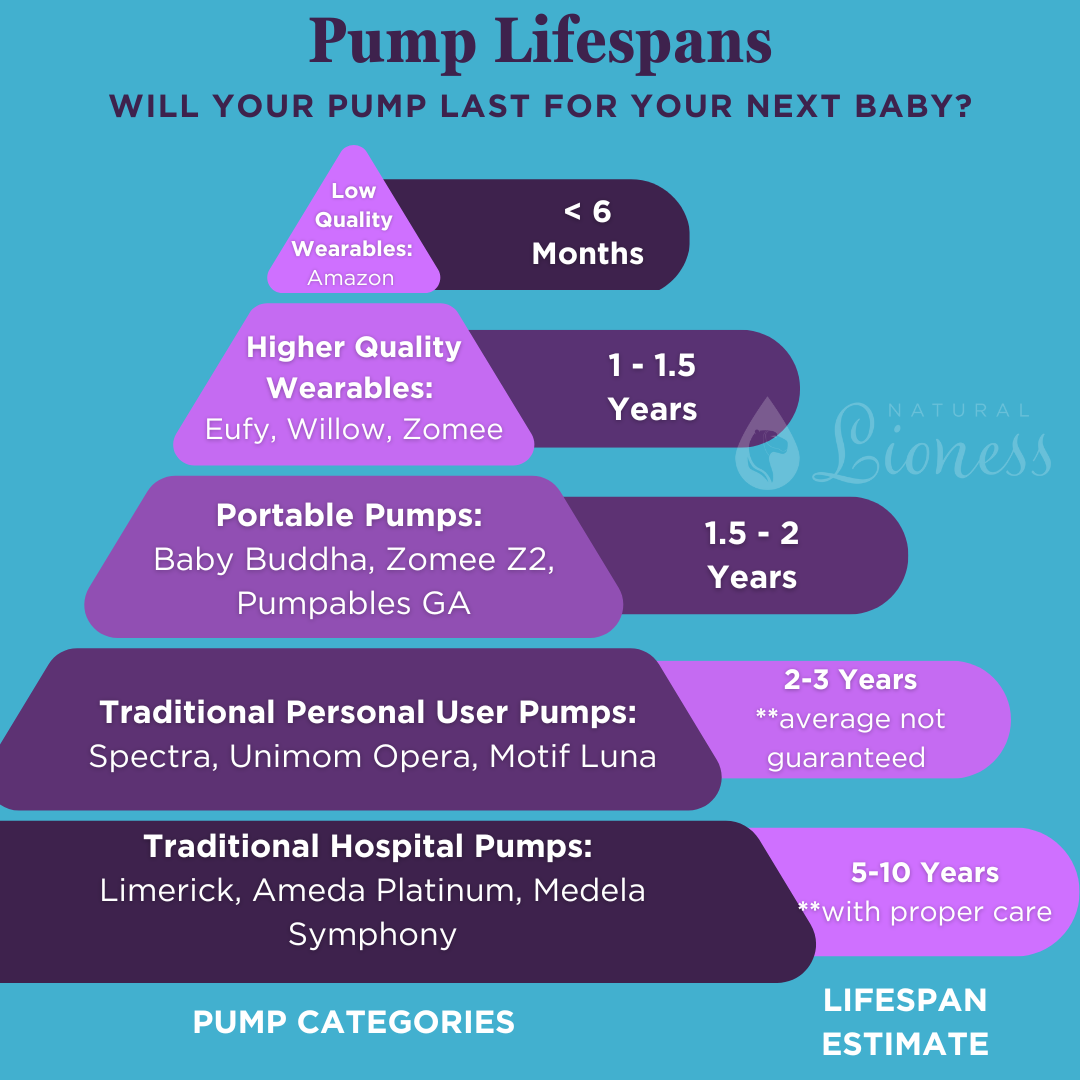
Note: Lifespan estimates are based on regular use of 2–4 sessions per day. Exclusive pumping at higher frequencies will shorten these timelines.
The Bottom Line
The breast pump market in 2026 offers more options than ever before — and more variation in quality than ever before. Understanding where your pump falls on the reliability spectrum, how long it can reasonably be expected to perform, and how to properly store and assess it can mean the difference between a thriving milk supply and a frustrating, unexplained plateau.
Your quick-reference checklist before storing or reusing your pump:
Identify your pump category and cross-reference with expected lifespan
Calculate how much of that lifespan has already been consumed based on your usage frequency
Store in a climate-controlled, clean, sealed environment
Plan to replace ALL consumable parts — tubing, valves, membranes — before the next use
Test at 34–36 weeks pregnant, before you actually need it
Check your insurance benefit for potential coverage on a new pump
When in doubt, consult a lactation professional before your supply is on the line
Your pump is a tool. Like any tool, it has a useful life — and knowing that life expectancy ahead of time puts you in control. You've already done the hard work of one nursing journey. Let's make sure your equipment is ready to support the next one, book your session here.
FAQ
-
In most cases, no. The miniaturized motors in wearable pumps simply aren't designed for multi-year lifespans the way traditional pumps are. If your wearable pump is approaching the one-year mark, it may be more economical and reliable to plan for a new pump for your next baby rather than gamble on an aging device during a critical supply-establishment window.
-
Faster than most people expect. Under typical use, degradation is gradual and may be imperceptible month to month — which is exactly what makes it so insidious. You're not going to wake up one day to a pump that suddenly doesn't work. Instead, you'll notice a slow shift: sessions take a little longer, output dips slightly, letdown feels less consistent. By the time it's obvious something is wrong, the motor has often been underperforming for weeks.
-
If your pump falls into the wearable category and has been used for a full nursing journey, replacing it for your next baby is worth serious consideration even if it appears functional. "Appears functional" and "performing optimally" are not the same thing, and the early postpartum period — when you're trying to establish supply — is the worst time to discover the difference. If insurance will cover a new pump with your next pregnancy, there's very little financial reason not to start fresh.
-
Thoroughly with an alcohol wipe, and with the understanding that no amount of cleaning will reverse motor wear. It will prevent contamination issues down the road. Disassemble all components that contact milk, wash with warm soapy water, and allow everything to air dry completely before storing. Never store any pump component while damp. Residual moisture accelerates mold growth and seal degradation. Once dry, store in a bag or the original packaging in a climate-controlled space.
-
In practice, yes. The miniaturized motors and compact seals in wearable pumps are more susceptible to degradation from environmental fluctuations — humidity, temperature swings, and extended periods of inactivity can affect the internal components more than they would in a larger, more robust traditional pump. A wearable pump sitting in storage for two years is a significant gamble, even if it was functioning well when you packed it away.
-
Light use tends to extend the timeline, but storage time itself is a factor — not just active use hours. Seals and rubber components degrade over time regardless of use frequency, and a pump stored for two years may have physically aged even if the motor hours are low. If you used your wearable pump only occasionally and stored it within the first six months of purchase, you have a better case for reuse than someone who pumped daily for a year. It still warrants a careful test run before you rely on it.
-
If it's a hospital-grade multi-user pump, yes — donation for active use is a legitimate option. For single-user consumer pumps that still work, some lactation educators and consultants keep retired pumps for demonstration and teaching purposes. You can also offer it to a community buy-nothing group with full disclosure that it is a single-user device not intended for another person's active pumping use — some people want them for display, cosplay, props, or parts. Just be upfront about what it is and what it isn't safe for.
-
The best first step is to check your pump manufacturer's website for any current take-back or recycling programs — brands like Medela have offered these periodically. If none are available, breast pumps are considered small electronics and can be dropped off at e-waste collection sites or retailers like Best Buy and Staples that accept small electronics recycling. Avoid tossing the whole unit in the regular trash if you can help it, as the motor and electrical components contribute to e-waste in landfill. Remove silicone and plastic accessories before drop-off, as most e-waste programs only process the motorized unit. If your pump is a true hospital-grade multi-user device and still functional, donation for active use with a new personal kit is also a great option.
-
Silicone parts like valves and membranes go in the regular trash — they're not recyclable through standard programs. Hard plastic components like flanges can sometimes go in rigid plastics recycling depending on your municipality, but check the resin code on the bottom first. Tubing is generally trash. If you're environmentally motivated, Medela and a few other brands have offered take-back or recycling programs in the past — it's worth checking your pump's brand website to see if any current program is available.
-
Technically yes for most consumer pumps, but it's not the most responsible option. Breast pumps contain electrical components, motors, and mixed plastics that contribute to e-waste when sent to landfill. Before defaulting to the trash, run through the other options below — most pumps have a better end-of-life path available.
-
Disassembled. Storing parts assembled traps any residual moisture between surfaces and increases the risk of mold or bacterial growth even after what appeared to be thorough drying. Storing disassembled also makes it easy to visually inspect each component when you retrieve them — you'll be replacing the parts anyway,.